Have you ever noticed how, in the middle of a boring lecture or a long meeting, your hand just starts doodling on its own? A swirl here, a triangle there, maybe even those endless little boxes that connect into each other? Most of us do it without thinking—and yet, it feels oddly calming. Strange, right? A pen and a scrap of paper somehow manage to hold the weight of our restless minds.
Now, here’s the thing: what if those scribbles aren’t just random? What if they’re a doorway into something deeper—something therapeutic? That’s the magic that people stumble upon when they meet Neurographica® (don’t worry if the word feels fancy, we’ll break it down). At its core, it’s the art of using simple lines, shapes, and colors to work through emotions, habits, and even the big, messy questions of life. And no, you don’t have to be an “artist” (whatever that means). You just need a pen, some paper, and maybe a little curiosity.
The Restless Mind We All Know Too Well
Let’s be honest: most of us are carrying around a crowded mental to-do list. Work emails, family calls, bills that need paying, that text you forgot to reply to three days ago—it’s endless. Add in the “big stuff” like career uncertainty, relationships, or self-doubt, and suddenly your brain feels like an overstuffed cupboard where everything falls out the moment you open it.
Here’s where drawing—yes, even the simple act of making lines—works like a reset button. Neuroscientists have long studied how repetitive, creative actions calm the nervous system. Think knitting, gardening, or even baking. Drawing works the same way: it occupies just enough of your brain to keep the anxious loops from spiraling. Instead of overthinking, your hands take over, and slowly… the noise begins to quiet down.
So, How Does a Line Help?
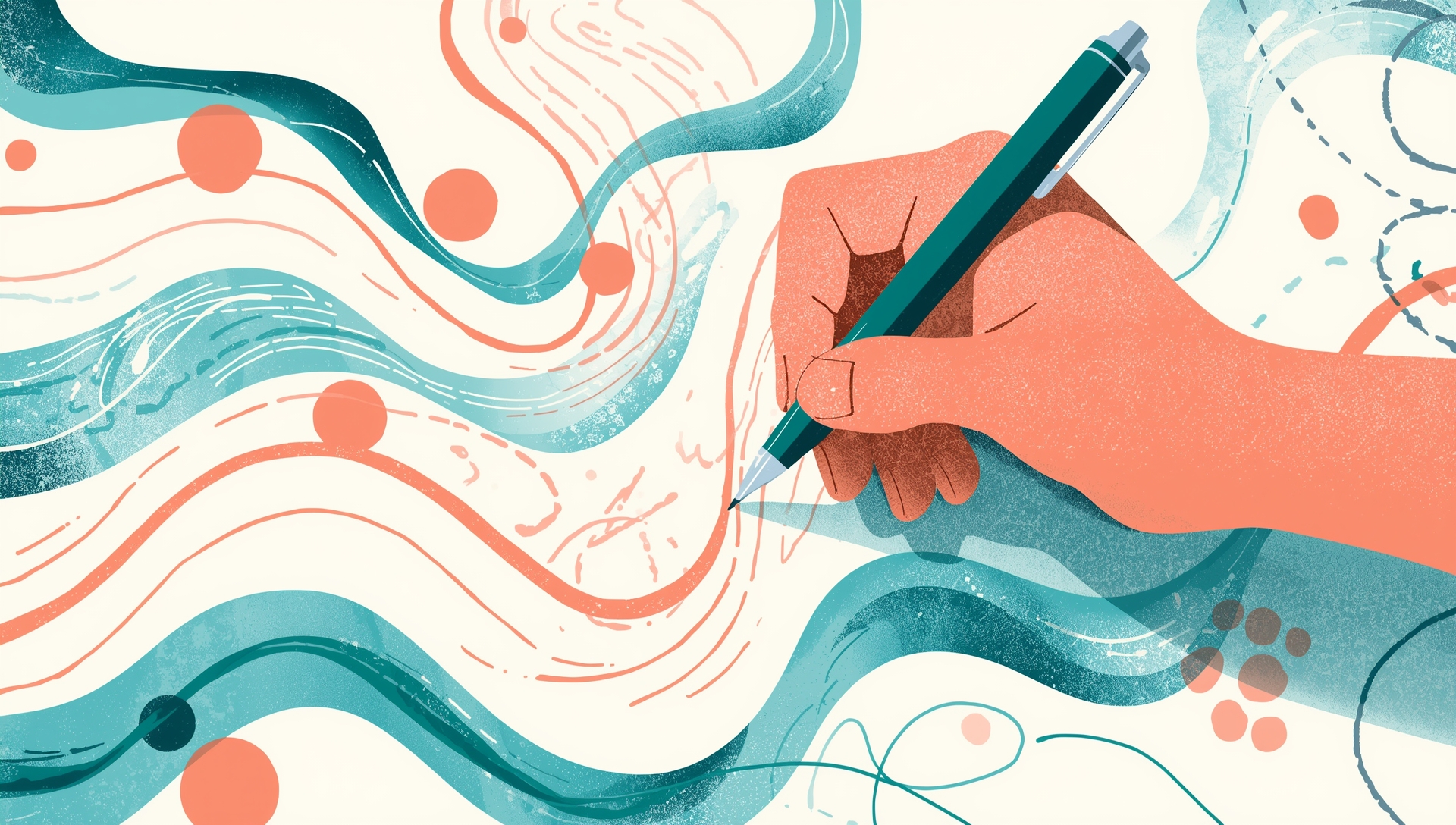
Alright, picture this: you draw a line across a blank page. At first, it’s just a line, no big deal. But then you curve it, maybe connect it with another line, maybe circle it. As the page fills, your thoughts—without you even realizing—begin to pour into those shapes. It’s like your inner chaos has found a safe place to sit.
This is why many people say drawing feels like “untangling.” Imagine a big ball of knotted yarn in your head. Each stroke of the pen gently teases a thread loose. Not all at once, but slowly, patiently, until suddenly it doesn’t feel so impossible anymore.
And sometimes, that’s all we need—not a complete fix, but a shift, a little bit of breathing room.
Real-Life Moments of Pen-Therapy
Let me give you a small, very human example. A friend of mine, let’s call her Rhea, had this habit of doodling spirals whenever she felt anxious. She thought it was meaningless, but she noticed something: after ten minutes of spirals, she could actually focus again. That’s not coincidence—that’s her nervous system finding regulation through movement and rhythm.
Or another story: a student I once worked with described drawing lines during a rough patch in her career. She didn’t know where life was heading, but she’d spend evenings filling pages with curves and connecting shapes. Later, she laughed and said, “It was like my pen knew the way forward before I did.” That’s the beauty here—sometimes art catches the emotions before our words can.
Not About Perfection (Seriously, Forget Pretty)
Here’s a trap a lot of adults fall into: “But I can’t draw.” We’ve been so conditioned to think art equals talent that we forget it can also just equal… expression. Therapy through lines isn’t about producing something “Instagram-worthy.” In fact, the more imperfect, the better—it means you’re being honest, not polished.
Think of it like journaling. Nobody reads your diary to judge your handwriting, right? The same applies here. Your page is a safe, private space. Scribbles welcome.
Why It Actually Works (A Tiny Bit of Science)
Without getting too heavy, here’s the nerdy part: when we draw, both sides of our brain—the logical left and the creative right—start working together. Add the hand movement, and your nervous system gets involved too. It’s like calling a family meeting inside your head: suddenly everyone’s at the same table, talking things through.
This integrative effect is what makes Neurographica® different from just casual doodling. It brings intention to the practice. Certain line techniques, specific patterns, and ways of connecting shapes can actually “rewire” old emotional patterns. Think of it as updating the mental software you’ve been running for years.
The Gentle Invitation
Next time your mind feels tangled, don’t rush for the phone or another cup of coffee. Just grab a pen. Let your hand wander without planning. Lines, loops, circles—let them grow into something. Don’t ask, “What is this supposed to be?” Instead, ask, “What does this feel like right now?”
Over time, you might find those pages becoming a private therapy room, one where you don’t need appointments or big explanations. Just strokes, and space, and you.
Because sometimes, healing isn’t about solving everything—it’s about finding a rhythm, a pause, a breath. And surprisingly, a pen might be the simplest doorway to get there.
Closing Thought
So, can a pen really be therapy? Maybe not in the clinical sense, but in the everyday sense—absolutely. It’s not about replacing professional help, but about giving your busy mind a friend, a way to rest. And honestly, in a world that’s constantly shouting for our attention, isn’t it kind of nice to know peace might be waiting in something as ordinary as a line on paper?